 |
Guitar Lessons that work!
A Visual Learning Experience, Lead Guitar Made Easy
Includes Over 150 online guitar lessons - Become better today!
Welcome to Guitar Secrets
Guitar Lessons that work!

Throughout our lessons, I've stressed how once you learn the Am pentatonic scale, you can use the same fingering patterns to play in other keys. Now is the time that you begin to do just that. We will work on a few different progressions that are not in the key of C major. The first progression we will play lead to, will be in the key of G major.
The Key of G Major has the chords that follow.
G Major, Am, Bm, C Major, D Major, Em F# dim. G
Em pentatonic would be the natural minor for the key of G. Check out key signatures before we begin. key signatures
G major pentatonic and Em pentatonic share the same notes and are relative to one another. If you are playing over the G chord or a progression in G major, use G major pentatonic, or Em pentatonic, but start on the G note.
Remember, the pentatonic root note fret fingering for all minor pentatonic scales will always be. 1-4, 1-3, 1-3, 1-3, 1-4, 1-4
So for Em pentatonic play 1-4, 1-3, 1-3, 1-3, 1-4, 1-4, at the12th fret.
The notes for Em pentatonic are: E, G, A, B and D
For G major pentatonic use
2-4, 1-4, 1-4, 1-3, 2-4, 2-4 at the 15th or 3rd fret for G major pent.
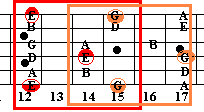
G, A, B, D, E, G. Notice that G major pentatonic and Em pentatonic share the same notes. If you played lead in the red box above you would be playing the Em pentatonic scale. If you played lead in the orange box, you would be playing the G major pentatonic scale. But you could use the red box for G major, just start on the G note.Play the Em chord and then play the notes in the red box.
Play the G chord and play the notes in the orange box.
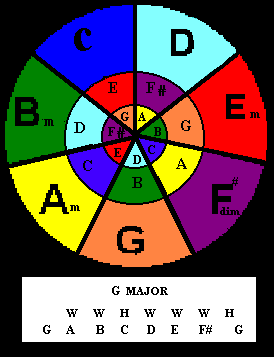
Look to the left and notice all of the chords in the key of G major.
For those of you who have purchased my CD Rom, please study the lead keys chapter. Also study major key theory and look over all the G major progressions included.
In every major key, there are always three major chords, three minor chords and a Diminished chord. Look above at the circle and find all of those chords.
G, C and D are the major chords. Am, Bm and Em are the minor chords. The F# is the diminished chord.
A popular progression for any major key is a 1, 4, 5 progression. I, IV, V. Since we are illustrating the key of G major, the G would be the I chord, the C would be the IV chord and the D would be the V chord. If your not up on chord formula's or roman numerals, please go back and review that chapter. Check out leading to modulation part 1 and return. Check out leading to modulation part II. I've stated throughout our lessons that every major chord has a relative minor. Each of those three major chords in the key of G and every major key has a relative or natural minor within that particular key.
The Em scale is relative or natural to the G major scale. Am is relative or natural to the C major scale. Bm is natural or relative to the D chord. These are always the same, no matter what key. For Example, the Am is relative to C in the key of C as well.
What does this all mean? This is really one of the most important things I have to tell you. This information is worth more than you will ever know. If you understand what I have to tell you, you will be a kick ass guitar player.
Once you know the natural or relative minor scales to the major scales, playing lead guitar will be very easy to understand. I have showed you how to play the Am pentatonic scale in every position for a reason. You should know the relative minor to every major. Each of these scales share the same notes, or key signatures. Check out key signatures to get an idea of what were talking about.
It is also very important to know where all of the chords are on the complete fretboard. If you know where you can play the C chord in every position, then you could also play lead over those same positions. To understand what I'm saying, check out the C chords and different locations you could play the C. C chord and locations. Once you review this example, print out some blank illustrations and fill in all of the chords of the key of C major in the same fashion. By using these illustrations on a regular basis, you will master the fretboard.
Putting it all together.
Since there are 3 major chords and three minor chords in every major key, then there must also be 3 major and 3 minor scales. We will be looking at the G major and Em pentatonic scales to start out. The progression we will be working on will be constructed for G major pentatonic. The pentatonic scale has only 5 notes. In G major the notes are:
G, A, B, D and E. The key of G major has 7 notes, G, A, B, C, D, E, F# and G.Play the G major chord. Remember what that chord sounded like. Now play the G major pentatonic scale, in the open position.
--------------------------------------0-3--
-------------------------------0-3--------
------------------------0-2---------------
-----------------0-2---------------------
---------0-2-----------------------------
-0-3------------------------------------ -This is also the Em pentatonic scale, but since we are strumming the G chord, we will concentrate on the notes of G major. We can also use the Em pentatonic root note fret at the 12th fret. 1-4, 1-3, 1-3, 1-3, 1-4, 1-4 below. But once again we need to concentrate on the G note. It should sound good, because the Em is natural and share the same notes of G major. You would always try to play on the notes of the chord your playing. For example, the notes that make up the G chord are, G, B and D. You would work around those notes for the G chord.
If we wanted to use the Em pentatonic scale for the Em chord, then we would write a progression based on the Em scale. This progression would look more like, Em, Bm, Am, Em. Or maybe, Em, D, Am, Em. The minor progressions tend to give the sadder sound compared to the major progressions that give that happy sound. I prefer the darker sadder sounds of the minors.
Illustration 1 G major and Em pentatonic scale.
The illustration above shows the G major pentatonic scale and notes. It also shows the Em pentatonic scale. These two scales have the same notes. G is the relative major to Em. Em is the relative minor to G major. Once again the pentatonic scale has 5 notes. Every pentatonic scale has 5 notes. For G major the notes are G, A, B, D and E. Notice that E is the 5th note. This means that in every major pentatonic scale, the 5th note will be the relative minor scale.
The notes of C major pentatonic are C, D, E, G and A. Notice that A is the 5th note. So A is the relative minor to C major.
When you write a song, you can write it based in a major scale or a minor scale. In this lesson we will start with a major progression in the key of G major. Strum the chords, G, C and D. Now play the notes of the G major pentatonic scale below. These notes will blend in nice with these chords. These chords are right out of the key of G major. You can play all of these notes over each of the chords in the progression G C D, or you can mix in different scales as you play over each chord.
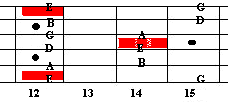
Illustration 2
Em pentatonic and G major pentatonic. Notice the G chord and Em chord in the Red box. G chord has the notes, G, B and D, Em has the notes, E, B and G.
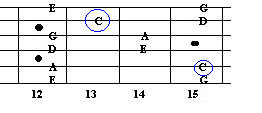
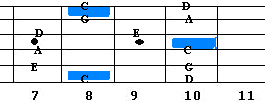
If you wanted to, you could play the C major pentatonic scale over the C chord. C major pentatonic and Am pentatonic share the same notes. So recall the position of Am starting on the 12th fret or position. Go back and check out this position, also go back and check out the position at the C note 8th fret Am pentatonic scale. Strum the C chord and play from C to C using the illustration below. You can play over the C chord C, E and G, using the Am pentatonic scale below. This will allow you to play the C major pentatonic scale and the G major pentatonic scale in the same position. Of course you could jump to the 8th fret and play the C major pentatonic scale or even the 5th fret and play the Am root note fret for the C. But concentrate on the C chord and notes.
Illustration 3
The illustration below shows the C major pentatonic played at the 12th fret. You can use this position to play over the C chord. Notice the only note that is different between C major and G major pentatonic. It is the C and B notes. G major pentatonic has the B note and C major has the C note. The other notes are the same. Eventually you will be learning the scales and how they relate to one another. Strum the C chord and then play the E note 14th fret, G note twice at the 12th fret then back to the E note 14th fret E G G E. These notes will fit over the C chord, because they are part of the C chord. CEG.
Strum the C chord again and play the same thing but use the E note 9th fret and G note 8th fret. EGGE, EGAGE, EGA (C8th fret) AGE, GE ( C10th fret)
So you can use these positions to play over the G chord or the Em chord. When it comes to the C chord you could stay here or play the C scale as illustrated above.
Illustration 4
C major pentatonic at the 8th fret. Same notes as above, but different location. Learn them both and memorize each position and note being played. If you moved this exact fingering two frets to the D 10th fret, it would now be D major pentatonic. You could use that position to play over the D chord. This is a must to learn because the D chord would be part of the progression and is a big part of the key of G major. D major is the 5th note of the key of G major which makes the D chord the Dominant chord in the key of G major. By the way the C chord would be the sub-dominant chord.
The Dominant chord wants to resolve to the tonic. This creates closure. The tonic would be the home note or 1st note. In the key of G, G would be the home note where everything will revolve around and come back to. Strum the C and D chords and see how they want to resolve to the G chord. When the G chord is strummed following those chords the progression has been completed or came to a final. This is why the I, IV, V progression is so popular.
Now try the same thing in the key of C major. C, D, E, F, G, A, B and C.
The I, IV, V progression in C major would be C, F and G. Strum the F and G chord and see how it resolves to the C chord. C is now the Tonic and G is the Dominant and F is the Sub-Dominant. This progression has a very strong cadence in how it resolves.
The minor progression is weaker. Am, Em and Dm would be a minor progression. Am is relative to C major, same notes. A, B, C, D, E, F, G and A.
This would be a i, iv, v progression using the natural A mino scaler. Strum this progression, Am, Em, Dm and Am. Notice it has that sadder sound and doesn't resolve or come to a closure like that C or G major progression. It also wants to go back to the Major key it is from. Try Am, G, Dm, Am this is another minor progression you can work on. Remember to play the minor pentatonic over the minor progressions and major pentatonic over the major progressions. Am pentatonic for the Am progression. C major pentatonic over the C major progression, G major over the G major progression. Or learn how to fit them all in over the same progression.
If this lesson helped you in any way, you should become a guitar secret's member and have access to A Visual Learning Experience, Lead Guitar Made Easy. You will find audio and video examples to help you become a well rounded guitar player. You owe it to yourself, become better today!
Good luck,
Guitar Secrets
Copyright 1998 - 2018 Guitar Secrets Inc. All rights reserved |